

 |
 |
 |
|---|
Watch the episode here
Listen to the podcast here
Download “The 10 Best Things To Know About Venture Debt” from https://7in7show.com/
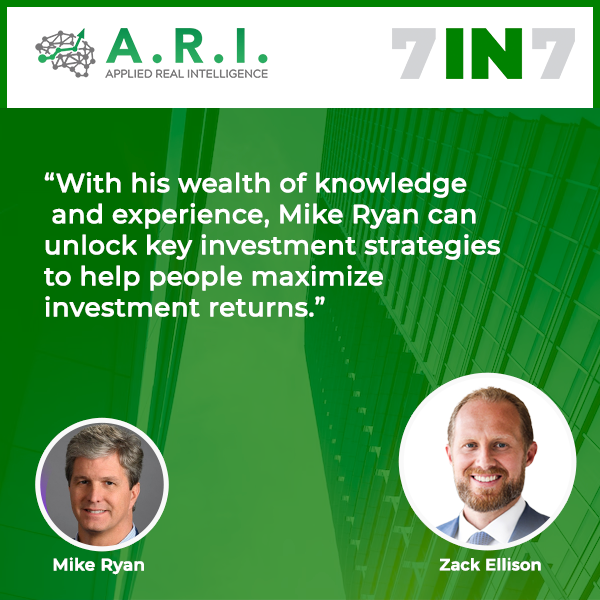
Mike Ryan, CEO of Bullet Point Network, shares his wealth of experience in finance and reveals key investment strategies for the current market environment. Dive into trends, risk management, and timeless investment principles that can make a difference in your portfolio.
In this episode Zack Ellison and Mike Ryan discuss:
- Balancing Growth and Profitability in Business
- The Importance of Financial Knowledge for Founders
- The Importance of People in Investment Decisions
- Navigating Market Shocks and Volatility
AI And Data: Powerful Tools To Maximize Investment Returns With Mike Ryan, Co-Founder, Bullet Point Network
Meet Mike Ryan
Welcome to the 7in7 Show with Zack Ellison. We have Mike Ryan, the CEO of Bullet Point Network. Mike is also the former Head of Global Equity Products at Goldman Sachs and the Head of Equities and Absolute Return at Harvard Management Company. Mike, thanks for joining.
It’s great to be with you, Zack. Thank you.
Before we dive in, tell us a little bit about your background.
I grew up in Staten Island, New York, and then went to Yale University, which was a great opportunity for me. I went there to play basketball and learn. I ended up coming out with my wife, my first job, and a set of relationships and skills that I have been benefiting from for three decades since. I went right to Goldman Sachs and spent about two decades at Goldman. I started out as an analyst. I consider myself an analyst today. That’s what I love to do. That’s what I do best.
I ended up sticking around with Goldman and was a partner at the time of the IPO, and for about eight years afterward, I eventually co-headed the global equity business for the firm. I went and started my own family office after leaving Wall Street. I still have that family office now, but maybe five years or so into doing that, Harvard University asked me to manage some money for the school’s endowment. I ended up managing about $6 billion of direct investments, plus another $12 billion that we allocated to other funds as an LP and co-investor.
I left Harvard to start Bullet Point Network, which is a software platform that we built, patented, and licensed to Harvard, and an analyst team. We work for and with growth equity funds, venture capital funds, and buyout funds mostly, building the strategic scenario model for the companies that they’re thinking about investing in. Sometimes, we continue to work with the companies themselves. We can talk later about the strategic scenario model and the framework, but that’s my background and my career in a nutshell. I have five kids and I am married. I am active in lots of things in New York, but I don’t know if we have time to talk about all that here.
Current Market Environment
Mike, it’s great having you on because you have such a diverse background and have had success everywhere you’ve been. In terms of what you’re thinking about, there are a lot of interesting things going on with Bullet Point Network. Is there anything you’re thinking about that you feel like the market is missing?
I don’t think the market is missing things. One of the things that’s fascinating to watch is how risks and opportunities that are hiding in plain sight get misunderstood or don’t get factored in thoroughly enough or properly enough. This is a very dramatic time. We’ve seen a massive change. The most important element of it is we’ve lived most of our lives or most of us have spent most of our professional lives in a world with virtually no inflation and with low and very stable, perhaps manipulated and compressed interest rates and risk premiums.
We’re now having to address the possibility that we’ll have real inflation for a decade or longer. That’s not unusual. If you think about 5,000 years of human history, that’s very common. For the last 40 years, that hasn’t been common. As people are coming to grips with that, there has been a real change in the way businesses operate and how you make money, running a company.
It’s going to change the way portfolios have to be managed and how you can manage risk and make money in an environment where you have non-zero interest rates, non-zero and positive persistent inflation, and a level of risk and volatility that’s more normal in a 100-year or 1,000-year history. It seems abnormal because it wasn’t there essentially for decades prior to maybe the last year.
Portfolio Construction
In terms of portfolio construction, what are the changes that you think PM will need to make for this new environment?
Diversification is a common word and everyone knows it’s super important. We get reminded of it whenever we have shocks and volatility. Everyone is going to revisit and redouble their thought process around how exposed they might be to some risks that double up or triple up in the same direction and how diversified their portfolio truly is. I, Graham, Dodd, and Warren Buffett would argue that it should never have been anything but front center, but profitability.
Growth is great. I’m a growth investor. I spend most of my time working with growth companies. There was a window where the markets weren’t requiring discipline about profits or a clear path to profitability. I think that’s a pretty long-term change. I’m not going to say a permanent change because I’m sure, like skinny ties, ignoring profits will come back into fashion at some point.
We had a window where it was absent. Now, everyone has got focus and religion on the fact that you better have profits or at least a clear path to profits. If you don’t understand that about your managers and how they’re thinking about that question or the underlying investments themselves, you need to rethink it because essentially, that’s the big change. It’s going to last but the next 5 to 10 years, not 5 to 10 minutes.
Growth Equity
We’ve been seeing that a lot in the early-stage ecosystem where the ship has gone from looking for companies that are very high growth to companies that can get to break even and have a steady run rate pretty quickly. You do a lot in growth equity. What are you seeing there in terms of themes and trends that are emerging?
Never bet against growth, innovation, technology, and the ability to do things better tomorrow as a society than we did yesterday. Share on XYou’re right, I am attracted to growth businesses. I never want to bet against growth, innovation, technology, and the ability to do things better tomorrow as a society than we did yesterday. That’s still a trend that’s worth betting on and looking for opportunities in. It’s critical now that the operators of those businesses and the investors in them appreciate that capital is scarce. It’s not ever flowing.
There was a window where interest rates were zero, and funding was available for series A, series B, and series C rounds at ever-increasing amounts without as much discipline on the return on capital and the profitability path that the companies were on. That has been a healthy change back to normal. It was the abnormal window that stood out when that wasn’t so much in focus.
Innovation, technology, disruption, and the ability to do things better than we were doing yesterday or last year are the best ways to invest because those companies have a competitive advantage. They have moat and sustainability, but you have to make sure that those statements are true and that they do have a sustainable competitive advantage. Otherwise, they’re not going to be able to fund themselves forever because the investors are going to require a little bit of results on that.
Core Investment Principles
What are some core investment principles that you live by? Do those shift in different roles, whether you’re an allocator at Harvard, for instance, or a PM or an asset owner potentially? Do you think that there are differences in principles that people should be utilizing or are they all the same? Which ones do you live by?
There are lots of fascinating questions, particularly with the juxtaposition between investing in funds or companies. One core principle that applies equally to both and is very important to me is people. I only want to invest and work with people who are trustworthy and competent. That sounds like a very easy standard. It actually rolled right off my lips, just simply trustworthy and competent. When you work with folks who are both of those things, the results can be exceptional.

Maximizing Investment: Risks and opportunities hiding in plain sight get misunderstood or don’t get factored in thoroughly or properly enough.
Unfortunately, most people fall down to some degree on one or other of those standards. In terms of investment principles and translating that, I think there’s a bit more commonality than most people do. Most great CEOs and business leaders themselves are good capital allocators. They’re good decision-makers. They think about allocating time, resources, and money to opportunities that will deliver returns.
Good leaders of businesses are good capital allocators and good decision makers. Share on XGood leaders of businesses are good capital allocators and good decision-makers. Good investment fund managers are good allocators of capital and good decision-makers. I like people who have the right balance on their team and in their own individual composition and brain, the right balance between being creative and being able to see and imagine opportunities and spot new trends, but also being systematic and disciplined, and having a rigorous repeatable scalable process to go through.
If you combine those two things where you’re open to and good at spotting opportunities and then you’re rigorous and systematic about how you go in a disciplined way through the analysis, you’ll get good results if you have that combination. It’s trustworthy and competent people who have a systematic rigorous people process. It works for fund managers, CEOs, and boards of companies.
Risk Management
On the flip side, what are the risks that keep you up at night? What do you think about risk management as part of the portfolio management and portfolio construction process?
The first principle of risk management is diversification and not putting all your eggs in one basket. Another good rule to live by is we think of considering scenarios. We’re very big believers in thinking about possibilities and probabilities. The seemingly unlikely events do happen. If you haven’t considered them in advance, you’re more likely to be a victim of problems in them. On the other end of the spectrum, the seemingly unlikely upsides also happen.
In a funny way, the odds of the outliers are one of the most important things to consider along with your thorough rigorous analysis of whatever you consider the most likely or base case. When you marry together diversification and not putting all your eggs in one basket with considering scenarios and the odds of the outliers, you have a pretty good recipe for risk management of all kinds. In some places, I’ve run derivatives businesses and I’ve done formal asset allocation work, which both tend to be very quantitative.
I’ve also looked at early-stage companies and investing behind founders, where all that’s going on is you are betting on the founder, the product, and the TAM. In both cases, it’s equally important to consider the odds of the outliers and consider scenarios or what success might unfold and what that might mean for the company, your portfolio, and your investment. I like the ability to think in terms of scenarios and try to quantify stories in terms of odds.
Putting together the principles that you live by and how you think about risk, are there investment strategies that you like for the next part of the cycle?
There are. There tend to be two great and timeless ways to make money. One is to correctly identify a trend that’s forceful and obvious, and invest in it, but be careful not to overpay. The second is to be a contrarian of sorts. You need to be early and visionary or to be contrarian and lean against the direction of sentiment, but then you have to be right. Being a contrarian who is wrong is very dangerous. Following an obvious trend but widely overpaying for it is very dangerous. I look for those situations.
One of the things that’s pretty interesting to me right now is there are a couple of kinds of businesses. People love for good reason SaaS businesses and recurring subscription businesses. They love them because recurring high-margin revenue is a holy grail of investing. Those businesses were dramatically appreciated with euphoria over the period of 2017, 2018, and 2019. They accelerated aggressively into 2021 post-COVID.
While they continue to be enormously attractive businesses to own, they did get somewhat overvalued in many places. Now, you’ve had a correction in values because interest rates and risk premiums have been appreciated and they’ve collapsed of the multiples that you have to pay for those companies. There are some very interesting opportunities around, but you have to be careful because you have to know the customer acquisition cost, the churn, and the ability to truly retain those high-margin revenues. You have to be careful about the evaluation.
That’s an area where it’s always been exciting to me. It was very expensive. Some things that were great businesses were not great investments because they were pricing in 50% to 100% growth for 7 to 10 years and they were pricing in 30% or 40% profit margins. The list of companies in history that have had 75% to 100% growth over 10 years and have 30% to 40% bottom-line profit margins is very small. The number of companies that were priced for that was very large. You had to understand what you were betting with and against.
Thinking hard about what was priced into the investment as the last stage of the decision-making process but a critical stage is something that I’m very attracted to. We’re now starting to see in public markets and private markets a lot of opportunities to buy great businesses at great prices that you can make money on instead of just owning a great business and not making a great return.
Venture Debt
We are in the startup ecosystem where we’ve been seeing difficulty in raising capital. Certainly, on the equity side, it has been very difficult for companies coming out of the boom years. Now, they’re seeing much smaller deal sizes and much higher cost of capital due to lower valuations. It’s taking deals a lot longer to get done.

Maximizing Investment: Identify a trend that’s forceful and obvious and invest behind it, but be careful not to overpay.
One of the themes that we’ve seen is the emergence of debt as an alternative or complement to equity financing for startups. This has gotten very interesting because we’ve had a number of regional bank failures like Silicon Valley Bank, First Republic, and Signature Bank. There will probably be more by the time people tune in to this episode. Lenders, in general, are pulling back.
I think we’re headed into a severe and prolonged credit crunch potentially. This is making it very difficult for startups to raise capital. A lot are looking towards debt and we’ve talked offline about the opportunities in both equity and debt. What are your thoughts on venture debt as an opportunity going forward?
Venture debt and just a full capital stack like a complement of financing tools and solutions are going to be part of the landscape for the next 5, 10, or 15 years. A lot of folks are looking at it wrongly as a window or a short burst of opportunity because the banks that you mentioned did fail. I think there is going to be just like there was the post so-called great financial crisis where private credit became mainstream. The alternative investment platforms and the non-bank lenders in that space have had a tremendous tailwind and growth. They’re very important now in the ecosystem for middle-market companies and even large-sized companies that are doing private credit.
The same is going to be true I believe for venture debt for the earlier stage and early growth stage companies. I also think a variety of convertible structures and hybrid structures are going to become very commonplace because as you alluded to, the need for capital or the demand for capital hasn’t changed. These companies still need capital to invest in R&D, invest in sales and marketing, and grow their business. The availability or the supply of capital has changed pretty dramatically.
There are far fewer IPOs going to the end of the spectrum. There has been a 90% reduction in IPOs, and we’ve seen this before over the last three decades. IPOs will come back. Probably not fast and not with the force of volume that was happening at the height, but less public market exit availability, be it SPAC and IPO, is going to be a real constraint.
Every investor is looking to see what the next chapter will be. Share on XFor private capital, there is still a lot of money in private equity hands and venture capital funds, but the volume of deals, the terms, and the availability of capital is markedly lower than it was at the height. That’s partly because of the endpoint. It’s harder to take a company public. It’s harder to get an exit. It sounds like almost a silly thing, but every investor is looking to see what the next chapter will be.
The seed investor wants to look ahead to the series A. The series A investor wants to look ahead to the series B and C. The series C investor wants to look ahead to either the strategic merger exit or the IPO. As those things become a little bit less frequent and a little bit less certain, animal spirits kick in and people are less willing to advance money.
You have far less equity available. Most of the rounds that are being done and publicized are, in one way or another, inside-led or inside-influenced rounds. The current cap table is taking the lead and they’re doing it for good and valid reasons. They know the company best. They’re also doing it in some cases to protect their prior investment. We have to recognize what the inside round validation is compared to new money coming in and investing which is a more credentializing moment.
Less available equity and less public market exits means you need more debt, you need more hybrid or convertible securities. Becoming smart about how to build a capital structure, who to work with, and who your lending partners and capital providers will be is going to become a core competency in the growth sector and to some extent, in the early venture stage of the startup phase.
Great points. We’re seeing that a lot in the sense that there’s just a lot more interest in learning about how to optimize the cap structure of early-stage companies. A lot of founders aren’t necessarily well-versed in finance. They’re not CFOs. They are company builders and are oftentimes visionaries and leaders in many respects, but they often don’t have expertise in managing their own capital structure.
That’s going to be a very interesting part of the market going forward because companies that can optimize their capital structure are going to have a competitive advantage over their peers. Ultimately, as a founder, the goal is to maximize the value of the company you build and your ownership in it. Historically, we’ve seen a lot of value go to the funders relative to the founders.
Oftentimes, the companies that did IPO were successful, so the majority of the gains go to VCs and other funders. The founders had a very small percentage of equity when the company was monetized. That’s one of the things that I see quite a bit. One of the reasons why founders are interested in learning more about venture debt when it finally gets on their radar is because they realize, “I can keep more of the company that I’ve built. Why would I not want to do that?”
I agree with that. One of the things that we look at Bullet Point Network all the time is we build cashflow scenarios. We boil it down and we quantify a story. We’re building logical probabilistic cases where the cashflow of the company is under different paths and different levels of success that they might experience, and then we’re doing valuation where we think about discount cashflow analysis and multiples analysis. We layer in a capital structure to that now, and we can look at capital structure differences.
Scenario planning is even more important when you have debt because if you fall below certain thresholds with debt in your capital structure, you face real consequences that could stop you from being able to continue as a company in the way that you wish to. You have to understand that. On the other hand, the availability of capital and those who have capital access to fund their growth is going to become a truly differentiating competitive weapon.

Maximizing Investment: Growth does solve a lot of problems. If your business is growing, you have a lot of opportunities for success.
You’re going to have the haves and have-nots. You’re going to have companies that have raised enough capital, have diversified sources, and have trusted good partners for both debt and hybrid and series A or B equity, and then you’re going to have those who don’t have access to capital and don’t have the right capital partners or funding sources. Those companies are going to be in trouble. Capital access and availability are going to be a competitive weapon for growth-stage companies.
In the past five years, prior to mid to late 2021, it wasn’t that much of a competitive weapon because everyone was getting funded. Now, it’s much more discerning and much more disciplined out there among equity providers and debt providers. Being able to navigate that is going to be a competitive weapon. Companies that think through it properly, do the correct scenario planning, and then have the right partners or right capital-providing solutions, providing partners on the debt convertible and equity side are going to be winners.
I 100% agree. Most companies fail in the early stage because they run out of cash. The ability to access capital and be well-capitalized is the number one factor that’s going to keep companies in business and allow them to achieve their full potential. I appreciate your thoughts on that because a lot of people don’t understand the role that debt plays. It’s improving in terms of the market’s understanding. We’re almost out of time. I wanted to ask you two last questions. One is in terms of the key investment themes over the next part of the cycle in broad strokes, what are the key themes that you’re thinking about that you think other investors should be thinking about?
Key Investment Themes
It’s easy to bet against growth at a moment like this and I don’t think it’s a good idea. You still want to be hyper-focused on companies that have a competitive differentiation and can build a moat around their product and service so that they can grow because growth does solve a lot of problems. If your business is growing, you have a lot of opportunities for success. The obvious corollary to that is you need to do so profitably. You need to have the ability to manage your costs and you’re developing a path to profitability.
Unit economics have always mattered a tremendous amount. Understanding the unit economics of a business and translating that into how that produces cashflow is the key for us. That’s what we do with our strategic scenario models. That’s what Bullet Point Network is built around doing well. In terms of sectors and areas, it’s obvious that software and technology are going to continue to grow as an important influence.
AI is having a moment and is very powerful and obvious as a trend. That’s something that fits into category one. It’s a powerful obvious trend, but you have to be careful not to overpay for it because there will be winners and losers. The valuations being ascribed are very lofty. AI and software are clear areas of focus. Digital health and healthcare continue to be pretty interesting as well. There’s a lot to be done there.
Lastly, a variety of businesses are being transformed by technology. It doesn’t fit a neat SaaS box always. Sometimes there’s hardware being sold. Sometimes, there’s hardware and then a subscription to follow, but the combination of a business that is using innovative products and then benefiting from some kind of recurring high-margin subscription business. Those combinations are interesting and they fall between the cracks because it’s not a pure SaaS investment. Some people are allergic to anything that has a hardware component to it. There are a number of interesting business opportunities and investment opportunities in there.
I couldn’t agree more. It’s all about innovation and figuring out how to access it safely and capture the upside while eliminating the downside. There’s a lot of ways to do that. Ultimately, it depends on the allocator’s preferences in many respects. We’ll see a lot more money flowing towards innovation than we ever have in the past and that trend is here to stay.
In my view, innovations are what drive value and create vision. That’s just the way it is. With that, the last question of the day is not related to investing. For folks tuning in, Mike’s son is one of the best hoops players in the country in college basketball. He transferred to North Carolina to be a Tar Heel in his final season. Mike, I wanted to ask you, who has a better jump shot? Do you think that the Tar Heels are going to win the title in 2024?
Cormac certainly had a better jump shot and he’s put more work into it. It’s a lot better than my jump shot, but I still like to get a few up. His shooting is a lot smoother. He believes and I’m betting with him that North Carolina is going to win the national championship in 2025. They have a great team. His role is something he’s excited about there. We’re “Go Tar Heels” now. He had a great four years at Notre Dame. He’s graduating from Notre Dame with an MBA as well as an undergraduate degree and 1,000 points scored. They won some games in the NCAA tournament. He has nothing but love for Notre Dame, but “Go Tar Heels.” Let’s win the nationals next year.
I’m rooting for him. I appreciate you coming on. This has been very educational for me and I’m sure for many people tuning in. For everybody who wants to learn more about Mike Ryan and your company, where should they find you? On LinkedIn or the internet. What’s the best way to contact you?
Two good ways to find me. I am on LinkedIn, Mike Ryan, and Bullet Point Network. Our domain name is BulletPoint.Network. We build strategic scenario models for venture capital, growth equity, private equity funds, and sometimes their portfolio companies. I’d be happy to talk to you about that. Also, on LinkedIn, you can find me and connect because knowing interesting people who are doing interesting things and are trustworthy and competent in their own spheres has been a great recipe for going through my career.
Mike, thanks again for coming on. It’s been great having you. Thanks, everybody, for tuning in to the 7in7 Show.
Important Links
- Zack Ellison on LinkedIn
- Applied Real Intelligence (A.R.I.)
- 7 in 7 Show with Zack Ellison on Apple
- 7 in 7 Show with Zack Ellison on Spotify
- 7 in 7 Show with Zack Ellison on YouTube
- 7 in 7 Show with Zack Ellison on Amazon Music
- Mike Ryan on LinkedIn
- Bullet Point Network
- Bullet Point Network on LinkedIn
- Bullet Point Network on Twitter
- Mike Ryan on Twitter
- 7 in 7 Show Disclaimer
About Mike Ryan
 Mike Ryan is the Co-Founder and CEO of Bullet Point Network. An active private investor, entrepreneur, and board member, Mike has almost 30 years of investment, capital markets, and management experience.
In addition to founding and overseeing BPN, Mike served as Board Chair of the Alpha Partners Technology Merger Corp and has been the CIO of MDR Capital, his family office, since 2009. Before founding Bullet Point Network, Mike served as Head of Public Equity and Absolute Return at the Harvard Endowment, Head of Global Securities (overseeing equities, fixed income, currencies & commodities) at Credit Suisse, and Partner and Head of Global Equity Products at Goldman Sachs, where he spent the first 18 years of his career.
Mike has served as a director, committee chair, and board chair on numerous corporate and non-profit boards and is a venture partner or advisor to several growth equity and credit funds. He graduated summa cum laude from Yale University with a B.A. in economics and was an Academic All-American in basketball.